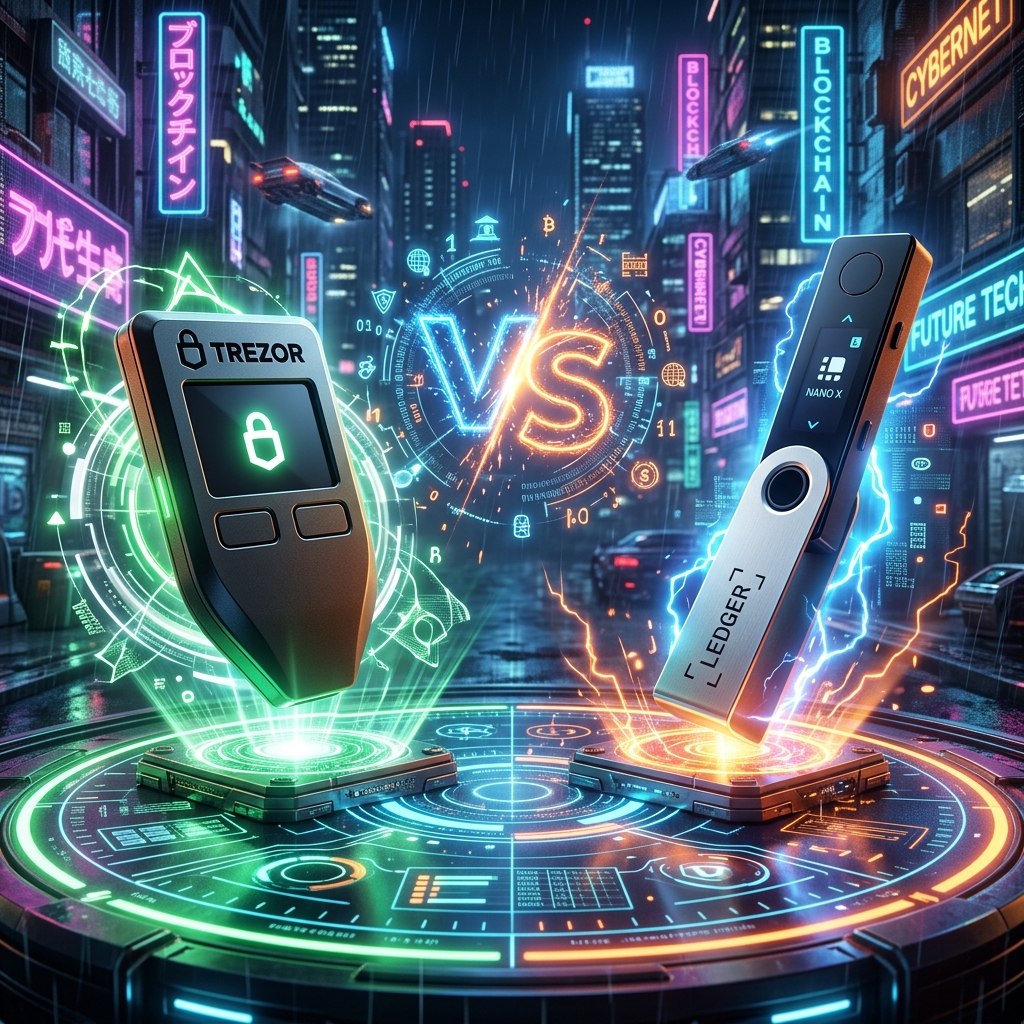
Trezor vs Ledger 2026: Which Hardware Wallet Is Best?
The classic hardware wallet duel: Trezor Safe 3 vs Ledger Nano S Plus. Security, open source, coin support, app and price — all compared for your decision.

Transparency: This article may contain affiliate links. If you register through our links, we may earn a commission at no extra cost to you. Our reviews are always honest and based on real testing.
The Duel That Defined the Hardware Wallet Market
When it comes to hardware wallets, the comparison most made in the crypto world is always the same: Trezor vs Ledger. Both founded in 2014, both defined industry standards, and both have decades of built reputation. In 2026, with the Trezor Safe lineup and Ledger's expansion to touchscreen models, the rivalry is more interesting than ever.
Quick Comparison: Trezor Safe 3 vs Ledger Nano S Plus
- Price: Trezor Safe 3 ~$79 / Ledger Nano S Plus ~$79 — tie
- Secure Element: both have one — tie
- Open Source: Trezor 100% / Ledger partial — Trezor wins
- Cryptocurrencies: Trezor 1,500+ / Ledger 5,500+ — Ledger wins
- Mobile App: Trezor limited / Ledger complete (Nano X) — Ledger wins
- Bluetooth: Trezor no / Ledger Nano X yes — Ledger wins
- Shamir Backup: Trezor yes / Ledger no — Trezor wins
- Privacy (Tor/Coinjoin): Trezor native / Ledger limited — Trezor wins
Security: Different Philosophies, Similar Results
Trezor's approach: complete transparency — all firmware, hardware, and software public on GitHub. Ledger's approach: formal certification — CC EAL5+ chip audited by accredited independent labs. The 2023 Ledger Recover controversy revealed firmware capabilities the community didn't expect, but for users who don't use Ledger Recover, practical security is equivalent to Trezor's.
For 99% of users using hardware wallets conventionally, both offer equivalent and more than sufficient security. The real difference is philosophical: do you prefer auditable code trust (Trezor) or formal third-party certification (Ledger)?
Cryptocurrency Support
Ledger's clearest win: 5,500+ vs 1,500+. For Bitcoin, Ethereum, and major altcoins, both cover everything. The difference appears with less common tokens. If you invest exclusively in BTC, ETH, and top 20 by market cap, Trezor covers all you need.
User Experience and Apps
Trezor Suite: functional desktop and web app with Tor integration and Coinjoin support. Major limitation: no native mobile app.
Ledger Live: the most complete management app among hardware wallets. Available for desktop and mobile (iOS/Android), with native staking for multiple assets, integrated swap, crypto purchases, NFT gallery, and DApp access. Ledger Nano X with Bluetooth enables cable-free mobile use.
Which to Choose in 2026?
Choose Trezor Safe 3 if you:
- Prioritize full open source and code transparency above all
- Are Bitcoin-focused with privacy concerns
- Want to use Shamir Backup for secure seed distribution
- Don't need native mobile app or Bluetooth
Choose Ledger Nano S Plus (or Nano X) if you:
- Want the most complete and polished management app
- Need support for many altcoins and different networks
- Want easy in-app staking
- Use mobile as primary device (especially Nano X + Bluetooth)
Verdict
There is no absolute "best" between the two — there is the best for your specific profile. Technically in 2026, the security difference between Trezor Safe 3 and Ledger Nano S Plus is minimal. The final decision comes down to: open source vs complete app. If code transparency is your main value, go Trezor. If user experience and broader asset support are your priority, go Ledger. You won't go wrong with either.
Frequently Asked Questions
Explore All Options
See the full listing with all available platforms, ratings and our referral bonuses.
See Full Listing Our #1 pick: access directly →